
Maths Prayer
Almighty God,
You hold the whole of creation in your hands,
Thank you for the hundredfold blessings,
Help us to multiply love and respect,
Share our talents, given to us by you, with others,
Add happiness and ideas and take away things that we have done wrong.
We grow together in God’s love,
In Jesus’ name,
Amen
Pslam
"Great is our Lord and mighty in power; his understanding has no limit".
Pslam 147:5
Maths Curriculum Intent
At St Anne’s, we believe that children should experience the awe and wonder of mathematics as they learn to solve problems; develop ways of looking at patterns; discover efficient strategies and make links between the different areas of maths. We believe maths is a universal language; it helps us to describe, make sense, investigate, understand and respect our ever-changing world. We believe all children can achieve in mathematics, and teach for secure and deep understanding of concepts through fluency, reasoning and problem-solving. Where possible, we try to make our maths ‘real’, making our learning and experiences relevant to everyday life. We use mistakes and misconceptions as an essential part of learning and provide challenges through rich and varied problems. We encourage children to use approaches, which work for them, by equipping them with a range of efficient strategies and ensuring an understanding of them. At our school, the majority of children will be taught age-related content and will be supported in understanding this through using our ‘St Anne’s 5 a day’ adaptive teaching strategies.

Maths Curriculum Handbook
Please select the document below.

|
Maths Curriculum Handbook | [pdf 398KB] |

|
How Maths is taught at St Anne's
We use White Rose Maths and Numicon.
White Rose Maths
A scheme of learning is a clear, time-linked plan for learning. Our schemes are written for year groups and cover the whole school year of learning. For each year group, the scheme of learning includes an overview of the maths that your child should be learning at any point in the year. Each year is split into three terms (autumn, spring and summer), and each term comprises individual blocks of learning about a particular topic.
Please click on the picture link for more information.

Numicon
Numicon are a system of flat plastic shapes with holes in them. Each shape represents a number from one to 10 and each number has its own colour.
Numicon can be used across EYFS, KS1, KS2, and to help bridge the gap to KS3. Numicon’s approach to teaching maths helps children to see connections between numbers, supporting children as they learn early maths skills in nursery, primary school, and beyond. It's a multi-sensory way of learning, which means children learn by seeing and feeling. This is great for kinaesthetic learners – children who learn by doing.
Physical resources like the colourful Numicon Shapes are an important part of Numicon. The holes in the Numicon Shapes represent the numbers 1 to 10. When they're arranged in order, as in the picture below, children can easily see connections between numbers, such as ‘one more’ or ‘one less’.

Numicon Shapes
Later on in their education, children will be able to use Numicon to see more complex mathematical ideas, like how two fours make eight, three twos make six, and so on. This lays the foundation for their understanding of numbers all the way through school.
At the centre of the Numicon maths teaching programme are Numicon shapes, which are a system of plastic shapes with holes in them. Each shape represents a number from 1-10 and each number has its own colour. Each Numicon shape provides children with a visual image of what a written number looks like in a physical, tangible form.
In this way, each Numicon Shape provides children with both a physical and a visual image of a number. Because of this, children start to recognise and explore the relationship between different numbers, as they notice the difference in shape, pattern and the number of holes in each Numicon Shape.
Using Numicon to Teach
Here are just a few topics we use Numicon to teach:
- Patterns –You can use the different shapes, colours and numbers to create a wide variety of patterns to demonstrate to children, or even challenge them to create their own.
- Ordering –Numicon shapes can be used to demonstrate putting items in a sequence, such as from biggest to smallest or by numeric value.
- Counting –By counting the holes in each shape and comparing their sizes children can begin to understand the order that numbers should go in.
- Early Calculating –Numicon shapes are great for practising simple addition and subtraction sums. Using the shapes that represent each number in the sum you can add and take away as and when needed and allow children to count at their own pace.
By giving children something physical – rather than just paper and a pencil – they develop confidence and a greater understanding of the concepts that they are being introduced to. Numicon helps to raise achievement across all ability levels.
As children get older Numicon can be used to help explore and explain slightly more advanced topics such as:
- Number order;
- Place value;
- Patterns;
- Number bonds to 10;
- Addition and subtraction;
- Odd and even numbers.
More complex ideas that Numicon can be used to demonstrate include geometric shapes and symmetry. You can use the Numicon shapes to create patterns to show children and see if they can identify whether it is symmetrical or asymmetrical.
Numicon can also be effective when children begin to learn times tables as this can be a tricky topic. Numicon shapes can be used to help children visualise the times tables, understand the patterns that occur in them, and make them seem a little less daunting.
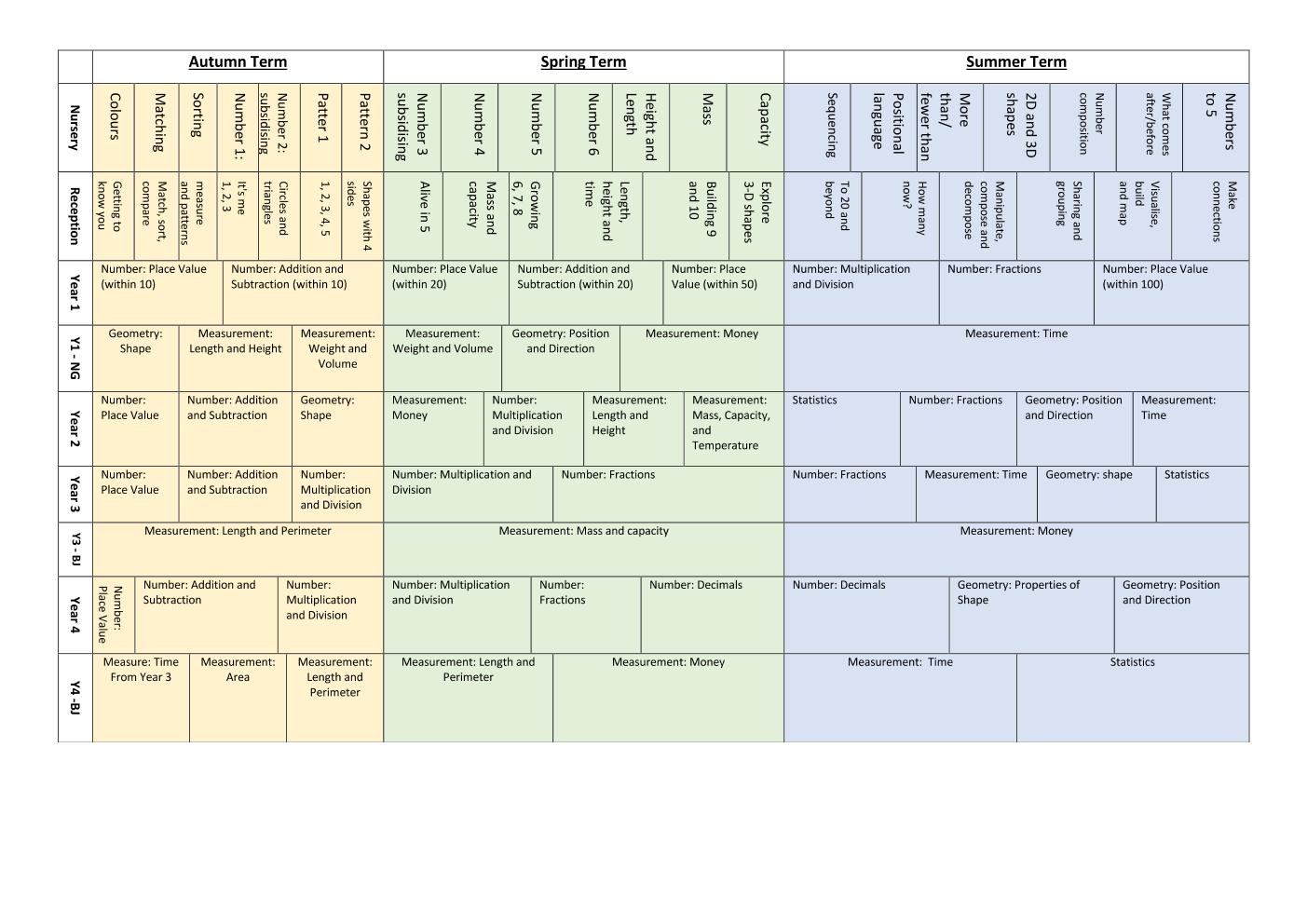
Maths Whole School Curriculum Overview
Please select the document below.
|
|
Maths Whole School Overview | [pdf 134KB] |
|
Maths Progression
Please select the document below.
|
|
Maths Progression | [pdf 362KB] |
|


Improving Mathematics in the Early Years and Key Stage 1
'Improving Mathematics in the Early Years and Key Stage 1' reviews the best available evidence to offer five recommendations for developing the maths skills of 3-7 year olds.
Recommendations include integrating maths into different activities throughout the day; for example, at registration and snack time; to familiarise children with maths language and make the most of the school day.
It also highlights that story and picture books can be a powerful tool for engaging children with basic maths concepts, while board games (such as Snakes and Ladders) are particularly beneficial to developing understanding of numbers.
We have used the findings of this report to inform the development of our Maths Curriculum. Please use the link to find out more.

Improving Mathematics in Key Stage 2
This guidance report focuses on the teaching of mathematics to pupils in Key Stages 2 and 3. Key stage 2 is years 3 to 6 at primary school. It is not intended to provide a comprehensive guide to mathematics teaching. We have made recommendations where there are research findings that schools can use to make a significant difference to pupils learning.
The focus is on improving the quality of teaching. Excellent maths teaching requires good content knowledge, but this is not sufficient. Excellent teachers also know the ways in which pupils learn mathematics and the difficulties they are likely to encounter, and how mathematics can be most effectively taught.
We have used the findings of this report to inform the development of our Maths Curriculum. Please use the link to find out more.

Maths Curriculum
Please click the links below to access the content of the National Curriculum by subject and by year group.

Maths School Learning Zone Resources
Please use the links below to access our learning resources.
 |
KS1 Maths Learning Resources |
|
KS2 Maths Learning Resources |