
At St Anne's RC our motto is: ALWAYS VIGILANT!
Safeguarding is crucial at St Anne’s. Safeguarding refers to the measures taken to protect the well-being, safety, and welfare of children, ensuring they are safe from harm, abuse, and exploitation. Our school is committed to safeguarding and promoting the welfare of children and young people. We expect all staff, visitors and volunteers to share this commitment. If you do have any concerns regarding the safeguarding of any of our pupils, please contact one of our designated safeguarding leads.
We have a number of policies and procedures in place that contribute to our safeguarding commitment, please visit our School Policies page. Sometimes we may need to share information and work in partnership with other agencies, when there are concerns about a child's welfare. We will ensure that our concerns about our pupils are discussed with parents/carers first, unless we have reason to believe that such a move would be contrary to the child's welfare.
We actively support the Government's Prevent Agenda to counter radicalism and extremism. Please find some useful resources below.

|
School Policies - Safeguarding Policies | Link |

|
Statement of Intent
At St. Anne’s, we believe that the protection of our children is an integral part of the ethos of the school. We seek to create an atmosphere in which children are recognised as unique and precious children of God. We seek to create a culture of openness and security where children are confident to talk to adults and are confident that they will be listened to.
The school will follow the procedures as laid down by the Oldham Safeguarding Children Partnership (OSCP), will respect issues of confidentiality and will give priority to working together with other agencies to protect children in our care particularly those, who have been identified as being at risk of child abuse.
Safeguarding and promoting the welfare of children is everyone’s responsibility who works or volunteers at St Anne’s RC Primary. Consequently, everyone who comes into contact with our children has a role to play in safeguarding and child protection. In doing so, all staff and volunteers should make sure their approach is child-centred. This means that they should consider what is in the best interests of the child?
We recognise that because of the day to day contact with children, staff and volunteers are well placed to observe signs of harm, abuse, neglect, victimisation and/ or exploitation. St Anne’s RC Primary will therefore ensure arrangements are in place to safeguard and promote the welfare of children by:
- Providing a safe environment where all children feel safe and secure,
- All children can approach any member of staff if they have a worry, The Child’s Voice being paramount
- Teaching students to keep themselves safe from all forms of abuse
- Provide opportunities for effective, ongoing training and development for all staff
- Proactive referrals to other agencies to address safeguarding concerns.
Safeguarding Implementation
Incorporating safeguarding into our curriculum helps to raise children's awareness of their rights, develop their understanding of personal safety, and equip them with the skills to protect themselves and seek help when needed. Our PSHE curriculum covers all areas of Safeguarding through each of the strands to a different degree, however some go into more detail. We are sensitive in our teaching and recognise that some more sensitive subjects need to be taught at an age appropriate level, or at a small group or 1:1 level where a more urgent need arises.
We plan to constantly challenge children to think deeply about safeguarding matters and their own personal physical and mental wellbeing. We value pupils’ questions and give them space for their own thoughts, ideas and concerns. We give them opportunities across the curriculum to explore values, personal rights, responsibilities and equal opportunities that develop moral concepts that impact positively on safeguarding, promote British values and prevent radicalisation and extremism.
Here are some ways in which safeguarding is addressed at St Anne’s:
Our Curriculum: Our broad curriculum gives pupils opportunities to experience life in all its diversity, to acquire knowledge, understanding and skills that significantly impact on personal development, behaviour and welfare and equips every child with the knowledge and skills required for personal safeguarding. A few examples: Science- the dangers of electricity; body anatomy; safety during experiments. History- learning from the past eg: The Holocaust; prejudice; tolerance and respect. RE- Individual liberty and persecution of those who speak out against injustice; PE- the importance of looking after our physical health; drugs, alcohol and tobacco. English: Key texts on stranger danger; road/rail safety.
Personal, Social, Health, and Emotional (PSHE) Education: We follow the scheme Jigsaw of work. Weekly PSHE lessons provide opportunities to teach children about personal safety, healthy relationships, self-esteem, and respect for others. It covers topics such as online safety, bullying prevention, consent, and emotional well-being. We have visits from school nurse team who deliver workshops on puberty, and personal hygiene.
Relationships, Sex and Health Education (RSE): We follow the Salford Diocese Ten:Ten Life to the full scheme. RSHE lessons are designed to help children understand healthy relationships and what constitutes unhealthy relationships (Domestic Violence), consent, and their bodies. These lessons emphasise the importance of respect, boundaries, and understanding feelings.
Mental Health: We have a team of trained youth mental health first aiders and adult mental health first aiders aswell as mental health ambassadors which raises the profile of mental health at St Anne’s. Mental health awareness week as well as regular assemblies led by Mental health ambassadors ensure children and well equipped at safeguarding their mental health.
Internet Safety and Digital Literacy: With the increasing use of technology, teaching children about online safety becomes essential. At St Anne’s we have an external company delivering our computing programme of study and includes lessons on responsible internet use, safe social media practices, cyberbullying prevention, and digital footprint awareness. Regular reminders on weekly newsletter to parents and links on the website ensure that parents and carers can support their child with E – Safety. (see Computing curriculum for further information).
Anti-Bullying Initiatives: St Anne’s incorporate anti-bullying programs and initiatives into the curriculum to raise awareness about different forms of bullying and strategies for prevention. This includes fostering a positive school climate, teaching empathy, conflict resolution, and providing clear reporting mechanisms. We celebrate anti bullying week every year as a whole school. We update our website and learning platform to include information for both children and parents on antibullying. Our school council usually lead our anti bullying campaigns throughout the year.
Child Protection Education: Children are taught about their rights, including the right to be safe and protected from harm. They learn how to identify trusted adults, understand boundaries, and recognise inappropriate behaviour. We also invite external professionals, such as police officers, PCSOs, NSPCC, Caritas and other agencies, to deliver talks and workshops. Children are taught about sexual harassment through the NPSCC Pantasaurus as well as through the PSHE curriculum.
Behaviour and Ethos: St Anne’s has a clear and well understood behaviour policy in which our core values of Love, Respect and Responsibility are constantly revisited with the school community. This culture of Growing together in God’s Love, ensures that children and staff are inclusive and foster a culture of ‘ safeguarding is everybody’s responsibility’
Health and Safety: St Anne’s ensure children cover basic health and safety principles, including fire safety (visit from local fire service, forest school), road and rail safety, poolside and water safety through swimming and first aid. Children learn how to identify potential risks, make informed decisions, and take appropriate action to protect themselves and others. Stanger danger is addressed through PSHE lesson aswell as Forest schools.
Pastoral Support: We have a dedicated pastoral worker who works specifically with families, children and groups of children to identify and address and specific safeguarding needs. Links with outside charities and agencies ensure our children’s needs are met.
We have developed an open and safe learning environment in which pupils express their views, seek help and help others, they make use of our worry box and worry recorders to share concerns with staff. The promotion of equality of opportunity and diversity, for pupils and staff, helps prevent any form of direct or indirect discriminatory behaviour. Our children learn to not tolerate any prejudiced behaviour. Our behaviour policy promotes making good choices and exhibiting good learning behaviours. British Values are celebrated weekly through assembly and children are taught how to identify British Values in school.
Our Designated Safeguarding Team
School local information:
St Anne's RC Primary (Appendix 6 of the policy information)
Headteacher: Mrs A Wainwright
DSL: Mrs A Wainwright
DDSL: Mrs L Holt; Mrs B Jones
Chair of Governors: Mrs A Entwistle
Safeguarding Governor: Mrs A Entwistle; Mrs B Pearson
Local Authority: Oldham
CSC: Oldham Mash 0161 770 7777
LADO: Colette Morris
Other useful contacts:
Attendance and Pastoral Lead: Mrs Holt
Emotional health and Wellbeing Lead: Mrs Holt/ Miss Comer
Internet Safety Officer: Mr Shaw
Health and Safety Officer: Mr Walsh
Educational Visits Coordinators: Mrs Jones
Fire Safety
Children that have an EHCP or SEND need have individual PEEPs (Personal emergency evacuation plans).
|
Appointed Person |
Deputy |
Area of Responsibility |
|
Mr Walsh |
Mrs Platt |
EYFS (Reception) |
|
Mr Walsh |
Mrs Platt |
Key Stage 1 (years 1 and 2) |
|
Mrs Jones |
Mrs Wood |
Lower Key Stage 2 (years 3 and 4) |
|
Mrs Jones |
Mrs Wood |
Upper Key Stage 2 (years 5 and 6) |
|
Mrs Spiller |
Mrs Holt |
Office Area |
|
Mrs Wainwright/Mrs Smith: Fire Warden |
||
First Aiders - Paediatric and First Aid at Work
All staff are First Aid trained.
First aid at work: Mrs Wood and Mrs Hoyle.
Outdoor First Aiders: Mrs Wood and Mrs Hoyle.
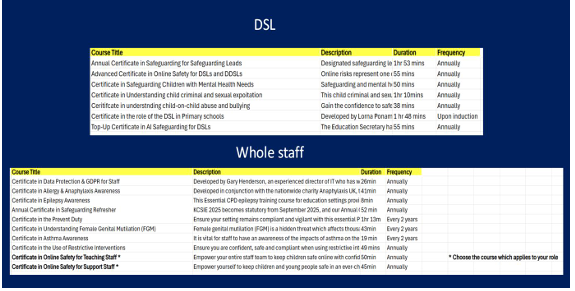
Safeguarding Training
All training is done via National College
The Designated Safeguarding Leads have face to face training every 2 years.
DSL and key staff have face to face safer recruitment training every 3 years.
Staff have KCSIE updates every September.
Other Key Training
| Fire Warden | Head Teacher Deputy Head School Business Manager All Fire wardens Site Manger |
Every 3 years |
Fire Awareness
|
All staff | Every 3 years |
| Asthma Training | All staff | Mnimum every 3 years and as required |
Emergency first aid and emergency Paediatric First Aid
|
All staff | Every 3 years
|
| Allergy and anaphylaxis Training | All staff |
Annually by school nurse |
| Child specific health conditions | Key Staff disseminated as appropriate
|
As required |
| Health and Safety Training | All staff New Staff
|
Every 3 years On induction |
Safeguarding Documents

|
Child Financial Exploitation Leaflet | [pdf 192KB] |

|

|
Working together to safeguard children | Link |
|
| Statutory guidance on multi-agency working to help, support and protect children. | |||
|
|
Information sharing to safeguard children and young people | Link |
|
| Statutory information sharing duty guidance for practitioners and organisations providing safeguarding and welfare services for children and young people. | |||
|
|
Keeping children safe in Education | Link |
|
| Statutory guidance for schools and colleges on safeguarding children and safer recruitment. | |||
|
|
Safeguarding disabled children | Link |
|
| Departmental advice setting out how agencies and professionals should work together to safeguard the welfare of disabled children. |
Operation Encompass
Operation Encompass is a police and education early information sharing partnership enabling schools to offer immediate support for children and young people experiencing domestic abuse. Information is shared by the police with a school's trained Key Adult (DSL) prior to the start of the next school day after officers have attended a domestic abuse incident thus enabling appropriate support to be given, dependent upon the needs and wishes of the child.
Children experiencing domestic abuse are negatively impacted by this exposure; domestic abuse has been identified as an Adverse Childhood Experience and can lead to emotional, physical and psychological harm. Operation Encompass aims to mitigate this harm by enabling immediate support, making a child's day better and giving them a better tomorrow.
Operation Encompass believes that children are victims of domestic abuse in their own right and should be acknowledged as such.
For more information please click on the link to visit their website Operation Encompass.
|
|
Operation Encompass Oldham for Schools with Appendices 1 to 5 | [pdf 377KB] |
|
Multi-Agency Safeguarding Hub (MASH)
The Multi-Agency Safeguarding Hub (MASH) is Oldham’s first point of contact for:
- safeguarding referrals to protect children, young people or adults from harm, abuse or neglect; and
- care and support services which help individuals or families to meet their long-term needs, access the Early Help Service and mental health support, prevent or delay needs becoming more serious, lead independent lives and reduce dependence on public services.
A range of organisations make up the MASH including:
- Social services for children and adults
- Greater Manchester Police
- Early Help
- Education and Early Years
- Pennine Care and Bridgewater NHS Trusts
- Healthy Young Minds Oldham
- Positive Steps
- National Probation Service
- Greater Manchester & Cheshire Community Rehabilitation Company
Where there is a concern, these organisations share information to decide the most appropriate intervention to prevent harm to the person. This gives a full understanding of the situation so we are able to respond quickly and effectively.
The MASH can also:
- Help with caring for someone or enabling them to live at home, or
- Support with problems such as housing, finance, family relationships, giving up smoking or weight management.
If you suspect a person is at immediate risk of harm call 999 and speak to the Police.
You can contact the MASH from 8:40am – 5:00pm on Monday – Friday.
- Telephone: 0161 770 7777
- Email: adult.mash@oldham.gov.uk (adults)
- Email: child.mash@oldham.gov.uk (children)
- Fax: 0161 770 1576