
Nursery and Reception Classes
Every child deserves the best possible start in life and the support that enables them to fulfil their potential. Children develop quickly in the early years and a child’s experiences between birth and age five have a major impact on their future life chances. A secure, safe and happy childhood is important in its own right. Good parenting and high quality early learning together provide the foundation children need to make the most of their abilities and talents as they grow up.
The Early Years Foundation Stage (EYFS) sets the standards that all early years providers must meet to ensure that children learn and develop well and are kept healthy and safe. It promotes teaching and learning to ensure children’s ‘school readiness’ and gives children the broad range of knowledge and skills that provide the right foundation for good future progress through school and life.
The Early Years Foundation Stage (EYFS) seeks to provide:
- quality and consistency in all early years settings, so that every child makes good progress and no child gets left behind
- a secure foundation through planning for the learning and development of each individual child, and assessing and reviewing what they have learned regularly
- partnership working between practitioners and with parents and/or carers
- equality of opportunity and anti-discriminatory practice, ensuring that every child is included and supported
Nursery Annual Curriculum Planning 2025-26
Please select the document below.
Reception Annual Curriculum Planning 2025-26
Please select the document below.
Early Years National Documentation
Please select from the documents below.

|
EYFS Statutory Framework from September 2026 | [pdf 748KB] |

|
|
|
EYFS Policy 2023 (Review Sept 26) | [pdf 156KB] |
|
|
|
Early Years Foundation Stage Profile Handbook November 2024 | [pdf 307KB] |
|
|
|
DfE Development Matters Report September 2023 | [pdf 24MB] |
|
Religious Education in Early Years
EYFS follow the same scheme as the rest of the school: ‘ The Way, the truth, the life’. The RE curriculum purposely builds upon prior knowledge of religious concepts, key figures and vocabulary. As a Catholic School the children learn about the Catholic Faith based around Jesus, his life and his teachings. Our EYFS children are encouraged to live out our mission statement ‘ We Grow together in God’s love’ and are encouraged to live their lives as Jesus lived his e.g. being kind, caring and sharing with each other. All children learn that they are talented and unique individuals who have a great contribution to make to the world in their own right.
Children say prayers daily in class and participate in prayer and liturgy choosing artefacts for their altar and engaging with scripture on a level that they understand. They are part of our whole school collective worship and write bidding prayers for our school newsletter.
“Be kind and compassionate to one another, forgiving each other, just as in Christ God forgave you.”
Ephesians 4:32
Curriculum Planning and Pedagogy
Our EYFS curriculum outlines ‘the what’ – the knowledge and skills we want our children to learn in nursery and reception. It then outlines ‘the how’ - this is how we teach the intended knowledge and skills.
Each half term, nursery and reception follow a theme. The themes are linked to what is happening in the children’s lives or what is happening around them. We value the importance of children being able to follow their own interests - therefore this curriculum remains flexible but intentional.
Our curriculum is ambitious, we have some ambitious curricular goals for our children that we want every child to access and make progress towards. We know that all children are not going to make the same progress towards the goal but all children are involved in the curriculum to make the best individual progress they can.
What do we want for our children?
We want our children to:
- Grow Together in God’s Love:
- be great communicators: through talking, writing and reading. We have created a language rich environment by reading a lot and talking a lot.
- be healthy - emotionally and physically:
1. We want our children to: Grow Together in God’s Love:
Here at St Anne’s our core values of love, responsibility and respect ensure all members of our community can live out our mission statement: ‘We Grow Together in God’s Love.’ Our high expectations and our clear behaviour policy ensures that all children are given the opportunity to achieve their full potential. Our highly motivated and dedicated staff ensure that all children feel part of God’s family and that they are encouraged to try their best in all that they do.
We pride ourselves on creating a broad and balanced curriculum in which all children can develop their God given talents and ‘live life to the full’ (John 10:10). Our aim is to provide a rich, fun-filled curriculum which develops the whole child through high quality teaching, learning and first hand experiences. Our children are at the heart of everything we do at St Anne’s and their emotional health and well-being is equally as important as their academic achievements.
2. We want our children to: Be great communicators: through talking, writing and reading. We have created a language rich environment by reading a lot and talking a lot.
Research shows that language is the foundation of learning, of thinking and underpins the development of later literacy skills. Improving children’s vocabulary is a high priority; a child’s vocabulary at 5 predicts how well they will learn to read and how well they will do in the school system. As children learn to read, those children with a good vocabulary inevitably understand the words they are reading. The understand the books and stories being read to them. This helps to facilitate an early love of reading, books and learning. At St Anne’s we read to the children and talk about what we have read. Those children who quickly learn to decode and read fluently want to read more and learn more. Shared reading, story-telling and explicitly extending children’s vocabulary are embedded and weaved throughout our curriculum. It is important to not leave learning to ‘chance’; it is important to plan specifically and systematically – step by step – to develop children’s vocabulary.
We take a two-step approach to creating our language rich environment:
- We read a lot - Children are read to everyday at least twice a day.
- We talk a lot - We follow the ‘Shrec’ model for ensuring high quality adult – child interactions.
We read a lot - Guaranteed Reading Spine:
These lists outline the collection of books we want all our Early Years children to hear, experience and enjoy.
- Favourite Five Booklist
- The Drawing Club Booklist (reception only)
- The Think Equal Booklist
- The Talk Through Stories Booklist
Favourite Five Booklist. Each half term nursery and reception have 5 different books which we repeatedly read. We believe these books are worth reading over and over and over again. They bring joy. The adults love reading them. The children love hearing them and joining in! If a child has attended both our nursery and reception, by the time the child leaves reception they will have heard 60 of these books over and over again.
The Drawing Club Booklist. (Reception only) The Drawing Club books are used as a stimulus for Reception’s communication, language and literacy sessions. We have mapped out stories, tales and animations which we know will delight our children. We have mapped out the vocabulary we ‘sprinkle’ on the children during these sessions. This vocabulary is not always in the book but vocabulary which relates to the book in some way. For example, the word ‘Gobble’ is not in the book ‘Not Now Bernard’ but it is a word we talk to the children about when we read this book. A word children enjoy saying. A word children can use during their own day in their own play. Children immediately start ‘gobbling’ their fruit at the snack table. This word is repeated again and again throughout the day and year in various contexts, until it makes its way into the children’s long term memory. When the children have the skills to read the word ‘gobble’ they have a deep understanding of what it means.
The Talk Through Stories Booklist: Talk through Stories sessions form the nursery’s communication, language and literacy sessions. For Reception, these sessions are for a planned, timetabled story time. The books are read and activities are completed in one session. There is then a separate vocabulary session at another time. There is a word of the day in both nursery and reception and these are tier 2 words taken from the book of the week. We explicitly teach these tier 2 words in a planned, timetabled session using various games – that the children love! These words are then practised throughout the day repeatedly. We have chosen words which we know children are going to be able to find examples of in our setting – therefore using the words in context of their own lives. For example, the word ‘hunted’ - our outside provision provides endless opportunities to hunt for worms, woodlice and so on.
The Think Equal Booklist: (Further information below)
We talk a lot: We use the ‘ShREC’ approach to ensure high quality interactions in EYFS. The aim of the ShREC approach is to provide our staff with a simple, memorable set of specific evidence informed strategies that are embedded into everyday practice. Adults are available to the children to have high quality adult child interactions; to have back and forth conversations; to model effective language; to model sentence structures and to extend children’s vocabulary.
- Share attention: be at the child’s level. Pay attention to what they are focused on
- Respond: Follow the child’s lead. Respond to their non – verbal and verbal communications. Maybe, make a brief comment on what they can see, hear, feel.
- Expand: Repeat what the child says and build on it by adding more words to turn it into a sentence.
- Conversation: Have extended back and forth interactions. Give children time to listen, process and reply.
Nursery rhymes, songs and poems:
Each half term nursery and reception have 5 different nursery rhymes or songs which we repeatedly sing with the children. These change each half term. In EYFS we have a daily nursery rhyme and song session. We also teach a new poem each half term. Singing nursery rhymes, songs and learning poems are likely to help children develop phonological awareness, as this develops we see children able to manipulate smaller units of sounds – phonemic awareness. Children develop the ability to manipulate the smallest unit of sound as well as tune in to rhyme, hear and understand intonation, sequence (nursery rhymes have a beginning, middle and end), learn new vocabulary, help with speech-sound development, develop mouth and tongue muscles and develop early mathematic skills.
Writing:
Transcription: Spelling
Children are taught to segment and blend sounds. When children can write they use ‘fred fingers’ to ‘pinch sounds’ to write words.
Transcription: Handwriting
Extensive practice is needed to develop effective handwriting (EEF). Through continuous provision children are given unstructured as well as structured opportunities to practice their mark making, writing and handwriting. We provide an array of attractive writing tools to capture attention and help motivate children to write some examples: gel pens, ‘teacher pens’, chalk, paint as well as pencils and whiteboard pens. We provide an array of media for children to write on: Some examples: note books, post it notes, a roll of paper on the floor for children to draw and colour whilst lying on their tummies. Accurate letter formation is an essential early skill that forms the basis of a fluent handwriting style. In turn, this supports writing composition. When children are introduced to a new sound in Read Write inc there is great emphasis on modelling to the children the correct letter formation.
Children are supported daily to develop their physical skills in order to hold a writing tool comfortably enough to mark make and later to write. Fine motor challenges permeate the classroom through continuous provision planning. Each morning, all children in EYFS complete their ‘morning jobs’ which is a weekly carousel of fine motor activities. In the afternoon, children in nursery will practice their name writing whilst reception children focus on letter formation. Children are introduced to handwriting guidelines in reception. Reception children learn to form their letters correctly using the Read, Write inc letter formation phrases coupled with phrases used during hand writing lessons. This allows children to find their own individual remembered phrase to help them to form letters correctly.
Composition (articulating ideas in speech before writing them down):
Oral and Writing composition:
Effective writing is underpinned by children’s expressive language capabilities. It is important, therefore, to develop and monitor children’s capability to formulate and articulate increasingly sophisticated sentences and later express them in writing. Literacy lessons and story sessions enable children to have access to a broad range of opportunities to develop their expressive language. Activities might include storytelling, group reading, or role play. Children orally rehearse words, captions, and later sentences with their talk partners with support from adults. Children use ‘sound buttons’ to record their own voices before writing down what they have rehearsed.
Children are taught that marks and symbols carry meaning. Children in EYFS are given lots of opportunities to orally rehearse their sentences before they draw, mark make, write singles letters, words, phrases and later write sentences. We enhance motivation for writing by modelling to and encouraging children to write for a range of purposes and audiences. Each half term there is a continuous provision writing focus across EYFS. These are meaningful opportunities for children to learn about the written word and supports children understand that symbols carry meaning. These opportunities are linked to the children’s own lives or a seasonal topic or festival and there are planned opportunities for children to share their writing with their intended audience.
3. We want our children to be healthy - emotionally and physically:
We use the ‘Think Equal’ programme to educate our children about emotional health. The programme uses a story as a starting point for each objective. These books are used as a stimulus for our Personal, social and emotional development sessions. Think Equal is a holistic Early Years Programme based on a commitment to social equality, gender, racial and religious equality, social and emotional health and well being and global citizenship, based in social-emotional learning. The programme views children as individual parts of a collective, global fabric and aims to support them as they begin a lifelong learning journey unburdened by the restraints of discriminatory mind-sets. It endows them with knowledge and experiential understanding of values and life skills or competencies such as empathy, inclusion, self-confidence, emotional literacy, self-regulation, peaceful conflict resolution, and so forth. It encourages and empowers them in assuming responsibilities as global citizens, and becoming ‘up standers’ and transformers of society through the use of critical, inclusive and creative thinking.
We have a great emphasis on outside play to enable our children to physically develop.
Areas of Learning Development
There are seven areas of learning and development that must shape educational programmes in early years settings. All areas of learning and development are important and inter-connected.
Three areas are particularly important for building a foundation for igniting children’s curiosity and enthusiasm for learning, forming relationships and thriving.
These are the prime areas:
- communication and language
- physical development
- personal, social and emotional development
Providers must also support children in four specific areas, through which the three prime areas are strengthened and applied. The specific areas are:
- literacy
- mathematics
- understanding the world
- expressive arts and design

Communication and Language Development
The development of children’s spoken language underpins all seven areas of learning and development. Children’s back-and-forth interactions from an early age form the foundations for language and cognitive development. The number and quality of the conversations they have with adults and peers throughout the day in a language-rich environment is crucial. By commenting on what children are interested in or doing, and echoing back what they say with new vocabulary added, practitioners will build children's language effectively. Reading frequently to children, and engaging them actively in stories, non-fiction, rhymes and poems, and then providing them with extensive opportunities to use and embed new words in a range of contexts, will give children the opportunity to thrive. Through conversation, story-telling and role play, where children share their ideas with support and modelling from their teacher, and sensitive questioning that invites them to elaborate, children become comfortable using a rich range of vocabulary and language structures.
Personal, Social and Emotional Development
Children’s personal, social and emotional development (PSED) is crucial for children to lead healthy and happy lives, and is fundamental to their cognitive development. Underpinning their personal development are the important attachments that shape their social world. Strong, warm and supportive 9 relationships with adults enable children to learn how to understand their own feelings and those of others. Children should be supported to manage emotions, develop a positive sense of self, set themselves simple goals, have confidence in their own abilities, to persist and wait for what they want and direct attention as necessary. Through adult modelling and guidance, they will learn how to look after their bodies, including healthy eating, and manage personal needs independently. Through supported interaction with other children, they learn how to make good friendships, co-operate and resolve conflicts peaceably. These attributes will provide a secure platform from which children can achieve at school and in later life.
Physical Development
Physical activity is vital in children’s all-round development, enabling them to pursue happy, healthy and active lives7. Gross and fine motor experiences develop incrementally throughout early childhood, starting with sensory explorations and the development of a child’s strength, co-ordination and positional awareness through tummy time, crawling and play movement with both objects and adults. By creating games and providing opportunities for play both indoors and outdoors, adults can support children to develop their core strength, stability, balance, spatial awareness, co-ordination and agility. Gross motor skills provide the foundation for developing healthy bodies and social and emotional well-being. Fine motor control and precision helps with hand-eye co-ordination, which is later linked to early literacy. Repeated and varied opportunities to explore and play with small world activities, puzzles, arts and crafts and the practice of using small tools, with feedback and support from adults, allow children to develop proficiency, control and confidence.
Literacy
It is crucial for children to develop a life-long love of reading. Reading consists of two dimensions: language comprehension and word reading. Language comprehension (necessary for both reading and writing) starts from birth. It only develops when adults talk with children about the world around them and the books (stories and non-fiction) they read with them, and enjoy rhymes, poems and songs together. Skilled word reading, taught later, involves both the speedy working out of the pronunciation of unfamiliar printed words (decoding) and the speedy recognition of familiar printed words. Writing involves transcription (spelling and handwriting) and composition (articulating ideas and structuring them in speech, before writing).
Mathematics
Developing a strong grounding in number is essential so that all children develop the necessary building blocks to excel mathematically. Children should be able to count confidently, develop a deep understanding of the numbers to 10, the relationships between them and the patterns within those numbers. By providing frequent and varied opportunities to build and apply this understanding - such as using manipulatives, including small pebbles and tens frames for organising counting - children will develop a secure base of knowledge and vocabulary from which mastery of mathematics is built. In addition, it is important that the curriculum includes rich opportunities for children to develop their spatial reasoning skills across all areas of mathematics including shape, space and measures. It is important that children develop positive attitudes and interests in mathematics, look for patterns and relationships, spot connections, ‘have a go’, talk to adults and peers about what they notice and not be afraid to make mistakes.
Understanding the World
Understanding the world involves guiding children to make sense of their physical world and their community. The frequency and range of children’s personal experiences increases their knowledge and sense of the world around them – from visiting parks, libraries and museums to meeting important members of society such as police officers, nurses and firefighters. In addition, listening to a broad selection of stories, non-fiction, rhymes and poems will foster their understanding of our culturally, socially, technologically and ecologically diverse world. As well as building important knowledge, this extends their familiarity with words that support understanding across domains. Enriching and widening children’s vocabulary will support later reading comprehension.
Expressive Art and Design
The development of children’s artistic and cultural awareness supports their imagination and creativity. It is important that children have regular opportunities to engage with the arts, enabling them to explore and play with a wide range of media and materials. The quality and variety of what children see, hear and participate in is crucial for developing their understanding, self-expression, vocabulary and ability to communicate through the arts. The frequency, repetition and depth of their experiences are fundamental to their progress in interpreting and appreciating what they hear, respond to and observe.

Communication and Language
ELG: Listening, Attention and Understanding
Children at the expected level of development will:
- Listen attentively and respond to what they hear with relevant questions, comments and actions when being read to and during whole class discussions and small group interactions;
- Make comments about what they have heard and ask questions to clarify their understanding;
- Hold conversation when engaged in back-and-forth exchanges with their teacher and peers.
ELG: Speaking
Children at the expected level of development will:
- Participate in small group, class and one-to-one discussions, offering their own ideas, using recently introduced vocabulary;
- Offer explanations for why things might happen, making use of recently introduced vocabulary from stories, non-fiction, rhymes and poems when appropriate;
- Express their ideas and feelings about their experiences using full sentences, including use of past, present and future tenses and making use of conjunctions, with modelling and support from their teacher.
Personal, Social and Emotional Development
ELG: Self-Regulation
Children at the expected level of development will:
- Show an understanding of their own feelings and those of others, and begin to regulate their behaviour accordingly;
- Set and work towards simple goals, being able to wait for what they want and control their immediate impulses when appropriate;
- Give focused attention to what the teacher says, responding appropriately even when engaged in activity, and show an ability to follow instructions involving several ideas or actions.
ELG: Managing Self
Children at the expected level of development will:
- Be confident to try new activities and show independence, resilience and perseverance in the face of challenge;
- Explain the reasons for rules, know right from wrong and try to behave accordingly;
- Manage their own basic hygiene and personal needs, including dressing, going to the toilet and understanding the importance of healthy food choices.
ELG: Building Relationships
Children at the expected level of development will:
- Work and play cooperatively and take turns with others;
- Form positive attachments to adults and friendships with peers;
- Show sensitivity to their own and to others’ needs.
Physical Development
ELG: Gross Motor Skills
Children at the expected level of development will:
- Negotiate space and obstacles safely, with consideration for themselves and others;
- Demonstrate strength, balance and coordination when playing;
- Move energetically, such as running, jumping, dancing, hopping, skipping and climbing.
ELG: Fine Motor Skills
Children at the expected level of development will:
- Hold a pencil effectively in preparation for fluent writing;
- using the tripod grip in almost all cases;
- Use a range of small tools, including scissors, paint brushes and cutlery;
- Begin to show accuracy and care when drawing.
Literacy
ELG: Comprehension
Children at the expected level of development will:
- Demonstrate understanding of what has been read to them by retelling stories and narratives using their own words and recently introduced vocabulary;
- Anticipate – where appropriate – key events in stories;
- Use and understand recently introduced vocabulary during discussions about stories, non-fiction, rhymes and poems and during role-play.
ELG: Word Reading
Children at the expected level of development will:
- Say a sound for each letter in the alphabet and at least 10 digraphs;
- Read words consistent with their phonic knowledge by sound-blending;
- Read aloud simple sentences and books that are consistent with their phonic knowledge, including some common exception words.
ELG: Writing
Children at the expected level of development will:
- Write recognisable letters, most of which are correctly formed;
- Spell words by identifying sounds in them and representing the sounds with a letter or letters;
- Write simple phrases and sentences that can be read by others.
Mathematics
ELG: Number
Children at the expected level of development will:
- Have a deep understanding of number to 10, including the composition of each number;
- Subitise (recognise quantities without counting) up to 5;
- Automatically recall (without reference to rhymes, counting or other aids) number bonds up to 5 (including subtraction facts) and some number bonds to 10, including double facts.
ELG: Numerical Patterns
Children at the expected level of development will:
- Verbally count beyond 20, recognising the pattern of the counting system;
- Compare quantities up to 10 in different contexts, recognising when one quantity is greater than, less than or the same as the other quantity;
- Explore and represent patterns within numbers up to 10, including evens and odds, double facts and how quantities can be distributed equally.
Understanding the World
ELG: Past and Present
Children at the expected level of development will:
- Talk about the lives of the people around them and their roles in society;
- Know some similarities and differences between things in the past and now, drawing on their experiences and what has been read in class;
- Understand the past through settings, characters and events encountered in books read in class and storytelling.
ELG: People, Culture and Communities
Children at the expected level of development will:
- Describe their immediate environment using knowledge from observation, discussion, stories, non-fiction texts and maps;
- Know some similarities and differences between different religious and cultural communities in this country, drawing on their experiences and what has been read in class;
- Explain some similarities and differences between life in this country and life in other countries, drawing on knowledge from stories, non-fiction texts and – when appropriate – maps.
ELG: The Natural World
Children at the expected level of development will:
- Explore the natural world around them, making observations and drawing pictures of animals and plants;
- Know some similarities and differences between the natural world around them and contrasting environments, drawing on their experiences and what has been read in class;
- Understand some important processes and changes in the natural world around them, including the seasons and changing states of matter.
Expressive Arts and Design
ELG: Creating with Materials
Children at the expected level of development will:
- Safely use and explore a variety of materials, tools and techniques, experimenting with colour, design, texture, form and function;
- Share their creations, explaining the process they have used;
- Make use of props and materials when role playing characters in narratives and stories.
ELG: Being Imaginative and Expressive
Children at the expected level of development will:
- Invent, adapt and recount narratives and stories with peers and their teacher;
- Sing a range of well-known nursery rhymes and songs; Perform songs, rhymes, poems and stories with others, and – when appropriate – try to move in time with music.
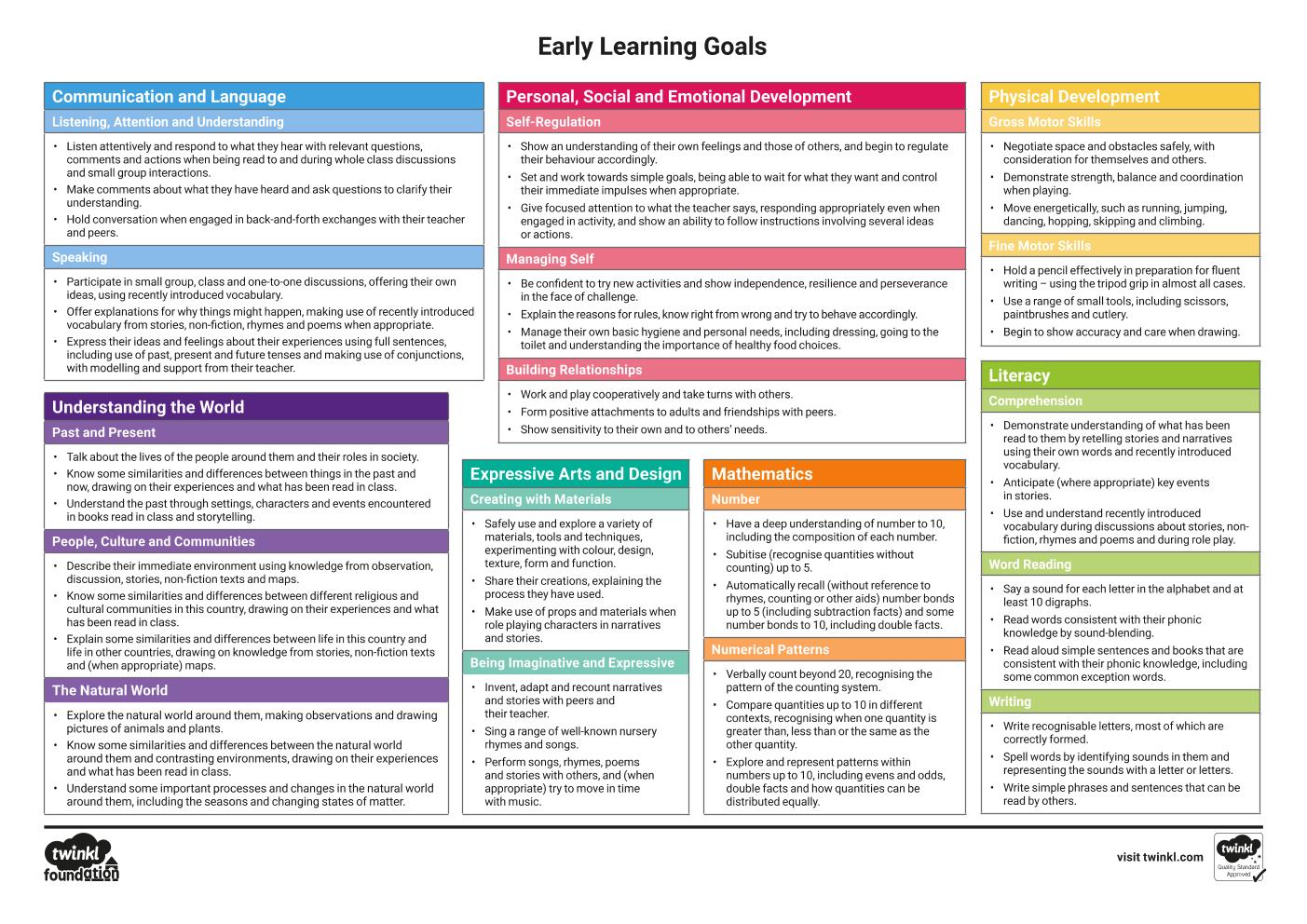
Early Learning Goals
The level of development children should be expected to have attained by the end of the EYFS is defined by the early learning goals (ELGs) as set out below.
|
|
Early Learning Goals | [pdf 137KB] |
|

Reception Baseline Assessment
The reception baseline assessment (RBA) is an assessment that must be administered in all primary, infant and first schools in England to pupils attending reception classes. To find out more please click on the picture link.